Xiaomi (Fortune Global 500)Product Manager, User Growth & AdsJul 2020 – Jul 2022Beijing
Overview概览
I've worked both sides of the ad business.
广告生意的两头我都做过。
At Xiaomi, one of the world's largest smartphone makers, I worked both sides of the ad market: spending ad money to bring new users to Xiaomi's game store, and earning ad money by selling the ad space in Xiaomi's browser.
Advertisers (Xiaomi Games) pay for people's attention. Ad platforms (Xiaomi Browser) sell it. I worked on both, so I know what each side counts as success.广告主(小米游戏)花钱买用户的注意力,广告平台(小米浏览器)卖注意力。这两边我都做过,所以清楚每一边怎么衡量成功。
The advertiser广告主The ad platform广告平台Userswho see the ads用户 · 看到广告的人
Buying ads: Xiaomi Games is the advertiser买广告:小米游戏是广告主
Xiaomi Gamesthe game store built into Xiaomi phones小米游戏:小米手机自带的游戏商店
pays for ads on付钱投广告
ByteDance, Tencent and Kuaishouthe companies behind TikTok, WeChat and Kwai字节跳动、腾讯和快手:抖音、微信、快手背后的公司
show the ads to把广告展示给
Users on those appson TikTok, WeChat and the rest这些 app 的用户:在抖音、微信等等上面
Install games and pay in them下载游戏并在游戏里付费Xiaomi Games shares what users spend with game studios.小米游戏和游戏厂商分成用户的消费。
Selling ads: Xiaomi Browser is the ad platform卖广告:小米浏览器是广告平台
From $0.10 to $1.20 back on every ad dollar每 1 美元广告费带回的钱,从 0.1 美元到 1.2 美元
I launched Xiaomi Games' Ads Manager platform with ML-driven smart bidding from 0 to 1: one console to run campaigns across three ad platforms, a value model to decide what each user is worth, and an automated ad creative workflow to keep up with the volume. It made our ad spending 12× more efficient.我从 0 到 1 上线了小米游戏的 Ads Manager 平台(广告管理后台,带机器学习智能出价):一个后台管三家平台的投放,一个模型决定每个用户值多少钱,一条素材流水线跟上投放量。它让广告花费的效率提升了 12 倍。
The business业务
Xiaomi Games is the game store built into Xiaomi phones. It co-publishes games from major studios and shares what users spend in them. To grow, it buys ads on ByteDance, Tencent and Kuaishou to bring in new users.
Project lead, with a 60-person team across engineering, machine learning, data science and operations. I introduced RTA bidding — the ad platform asks us, for every single ad slot, whether this person is worth an ad, and we answer within milliseconds (explained in full below) — set the success metric, planned the roadmap and designed the bidding rules. The machine-learning team trained the models; ad operations ran the campaigns.
A cheap install isn't a valuable user.便宜的安装,不等于有价值的用户。
We were buying ads almost blind. Ad operators picked audiences by age, gender and interests, and bid the industry-average price — the same for every user. Nobody was using the signal that mattered most — who actually pays, and how much. It stayed inside Xiaomi, unused at the moment of bidding: the ad platforms got conversion events like installs back from us, but not our data on what each user was worth. (ByteDance and Tencent publish games of their own, so they compete with Xiaomi Games; that data stayed in-house.)
Every $1 of ads brought back just $0.10 of user spending within 30 days.每 1 美元广告费,30 天内只带回 0.1 美元的用户消费。
Ad spendper user acquired, indexed每获取一个用户的广告费,按 1 计
$1.00
User spending within 30 daysbefore the platform · 30-day ROAS 10%平台上线前 · 30 日 ROI 10%
$0.10
The question to answer, ad slot by ad slot: is this user worth an ad, and how much?
要逐个广告位回答的问题:这个用户值不值得投,值多少?
Two more problems got worse as spend grew.另外两个问题,投得越多越明显。
Three back-ends, all by hand.三个后台,全靠手工。
ByteDance, Tencent and Kuaishou each had their own console. Every campaign, audience and budget change had to be made three times — once in each, by hand.
字节、腾讯、快手各有一个后台。每个计划、人群、预算的改动,都要在三家各手工做一遍。
Ads made by hand.素材全靠手拼。
About 1,000 ads a week, assembled by hand — not enough once spend started to grow.
每周约 1,000 条素材,全靠人手拼,投放量一上来就不够用了。
2Customer persona客户画像
The operator who spends, the partner who shares.花预算的运营,分收入的伙伴。
LinLin
Ad operations lead, Xiaomi Games小米游戏投放运营负责人
Who
Runs the acquisition campaigns on ByteDance, Tencent and Kuaishou; owns the daily budget.在字节、腾讯、快手上跑获客投放;管每天的预算。
Pain
Picks audiences by intuition and learns a cohort's value — what one batch of new users went on to spend — a month after paying for it. Sets up every campaign three times, once in each platform's back-end, and runs out of fresh ads as spend grows.凭经验圈人,付完钱一个月后才知道这批人(同一批装机的新用户)值不值。每个计划要在三家后台各建一遍;投放量一上来,新素材就不够用。
Wants
To bid more for users who will pay and skip those who won't, without a data team on call — and to run all three platforms from one place.对会付费的用户出高价、跳过不会的,而且不用随时找数据团队;三家平台在一个地方管。
"I can see installs today. I see payers next month.""装机今天就能看到,付费要等下个月。"
ZhouZhou
Partner manager, game studio游戏厂商合作经理
Who
Co-publishes titles on Xiaomi Games and shares what users spend.在小米游戏联运游戏,分成用户的消费。
Pain
Install counts look good; the revenue share doesn't follow.装机数好看,分成却没跟上。
Wants
New users who pay, and a number that shows the campaign pays for itself before it scales.会付费的新用户,以及一个能证明"放量前已回本"的数字。
"Don't send me installs. Send me users.""别给我装机数,给我用户。"
3Customer journey map客户旅程图
One campaign, before and after the platform.一次投放,平台前后。
Lin's week, from picking an audience to reading the result.
Lin 的一周:从圈人到看结果。
1Pick the audience圈人
2Set the bid出价
3Launch上线
4Watch盯盘
5Read the result看结果
Before之前
Age, gender, interests, by hand.按年龄、性别、兴趣手动圈
Industry-average price.行业均价
Upload the ad creatives (images and copy); launch.上传广告素材(图片和文案),上线
Installs and cost per install, daily.每天看装机数和单价
30-day ROAS arrives a month later: 10%.一个月后才知道 30 日 ROI:10%
Feeling心情
guessing猜
"same as everyone""和大家一样"
hopeful有希望
anxious焦虑
"too late to fix""来不及改了"
After之后
Paying users as seeds → lookalike groups (people who behave like them), by value.付费用户做种子 → 找行为相似的人,按价值分组
A bid tier per group; later, a bid per person.每组一档出价;后来逐人出价
RTA answers every ad slot: skip, or bid.RTA 逐个广告位回答:跳过,或出价
7-day ROAS as the in-flight gate (the early check while a campaign runs).7 日 ROI 做过程关卡(投放进行中的早期检查)
30-day ROAS by install cohort, on a dashboard.看板上按装机批次看 30 日 ROI
Metric指标
Share of spend on high-value groups高价值人群的花费占比
Bid vs. predicted value出价 vs 预测价值
RTA response timeRTA 响应时长
7-day ROAS7 日 ROI
30-day ROAS30 日 ROI
4User stories用户故事
Three teams, three promises.三个团队,三个承诺。
As Lin, the ad operations lead, I want to bid more for users likely to pay and skip those who won't, so that 30-day ROAS stays above target as spend scales.作为投放运营负责人 Lin,我想对可能付费的用户出高价、跳过不会付费的,这样放量时 30 日 ROI 仍高于目标线。
As the algorithm team, I want a clear prediction target and a clear release bar, so that we know when a model can go live.作为算法团队,我想要清楚的预测目标和上线标准,这样知道模型什么时候能上。
As Zhou, a studio partner, I want to see new users' 30-day spending by title, so that I agree to scale the budget on evidence.作为游戏厂商合作方 Zhou,我想按游戏看到新用户前 30 天的付费,这样能基于证据同意放量。
5Acceptance criteria验收标准
What I wrote for the teams.我写给各团队的验收线。
Story故事
Criteria标准
S1 · Bidding
PerformanceThe RTA response returns within tens of milliseconds; on timeout, fall back to the default bid. FunctionalityBelow the value threshold, no bid; above it, bid ≤ predicted 30-day value ÷ target ROAS. ReliabilityFirst-party data (Xiaomi's own install, gameplay and payment records) never leaves Xiaomi; only the decision does.性能:RTA 几十毫秒内回复;超时回退默认出价。功能:低于价值阈值不出价;高于阈值,出价 ≤ 预测 30 天价值 ÷ 目标 ROI。可靠:第一方数据(小米自己的安装、游戏行为、付费记录)不出小米,只有决策出去。
S2 · Model release
FunctionalityThe target is each user's spending in the first 30 days. PerformanceOffline evaluation first, then a live A/B test — half the budget on new bids and half on old — promote only if 30-day ROAS improves.功能:预测目标是每个用户前 30 天的付费。性能:先离线评估,再线上 A/B——一半预算新出价、一半旧出价,30 日 ROI 更好才替换。
S3 · Partner view
FunctionalityDashboard shows 30-day ROAS by install cohort and title, updated daily; 7-day ROAS as the in-flight gate. GuardrailBudget scales only while ROAS stays at or above target.功能:看板按装机批次和游戏显示 30 日 ROI,每日更新;7 日 ROI 做过程关卡。护栏:ROI 不低于目标线才放量。
6Product roadmap产品路线图
Machine learning went last, not first.机器学习放最后,而不是最先。
A model can only learn from conversions (installs and payments) we didn't yet have. So: manual campaigns to get data flowing, tiered bids by user value, then ML bids per person.
模型只能从转化数据里学,而那时数据还没有。所以先人工投放让数据流起来,再按用户价值分档出价,最后逐人 ML 出价。
Paying users as seeds → lookalike groups by value; one bid tier per group.付费用户做种子 → 按价值分组的相似人群;每组一档出价。
Per-person 30-day value prediction; through RTA, skip below the threshold, bid up to value ÷ target ROAS above it.逐人预测 30 天价值;通过 RTA,低于阈值跳过,高于阈值按价值 ÷ 目标 ROI 封顶出价。
Data & model数据与模型
Collect installs and payments; attribution by device ID.积累安装、付费数据;按设备 ID 归因。
Payment data connected to the Ads Manager platform.付费数据接入 Ads Manager 平台。
Value model trained on real payments; offline evaluation + live A/B before release.用真实付费训练价值模型;先离线评估,再线上 A/B。
Creative & ops素材与运营
Hand-assembled creatives: ~1,000 a week, 5 people.人工拼素材:每周约 1,000 条,5 人。
ML similarity-matching assembly with human review: 3,000 a week, 3 people, click-through rate (CTR) +10%.ML 相似度匹配拼装 + 人工审核:每周 3,000 条,3 人,点击率(CTR)+10%。
Result结果
30-day ROAS 10%30 日 ROI 10%
Bids start to follow user value.出价开始跟着用户价值走。
30-day ROAS 120% · $45M+ a year30 日 ROI 120% · 每年 $45M+
7Risk风险
What could have gone wrong.哪里可能出问题。
Risk风险
Type类型
Mitigation应对
The model has nothing to learn from on day one.第一天模型无数据可学。
Schedule
Three-phase sequencing: manual campaigns first, so installs and payments start flowing.三阶段排序:先人工投放,让安装和付费数据流起来。
Real-time integration: latency and data exposure.实时接入:延迟与数据外流。
Technical
Only a skip-or-bid decision leaves Xiaomi, within tens of milliseconds; timeouts fall back to the default bid.出小米的只有"跳过或出价"的决策,几十毫秒内返回;超时回退默认出价。
Optimizing for installs instead of payers.只优化安装、不优化付费。
Metric
30-day ROAS as the north star (the one metric the team optimizes), 7-day ROAS as the gate; installs are never the goal.30 日 ROI 做北极星(团队唯一优化的那个指标)、7 日 ROI 做关卡;装机数从来不是目标。
Scaling spend before efficiency is proven.效率没证明就放量。
Budget
ROAS ≥ target as the precondition; budgets grew only as ROAS rose.以 ROI ≥ 目标线为前提;预算只随 ROI 上升而增长。
Automated creatives trade quality for volume.自动化素材以质量换数量。
Quality
A person reviews every creative; A/B against hand-made ones; CTR +10% as the bar.每条素材人工审核;和人工素材 A/B;以 CTR +10% 为门槛。
8Business model商业模式
Lean canvas.精益画布。
A one-page summary of how the product makes money, and for whom.一页纸说清这个产品怎么赚钱、为谁赚钱。
Problem问题
Users bought almost blind: installs ≠ payers.几乎盲投地买用户:装机 ≠ 付费。
Platform targeting predicts clicks, not who pays.平台定向能预测点击,预测不了付费。
Our payment data sat unused at bidding time.我们的付费数据在出价时没用上。
The first release did one thing: through RTA, answer each ad slot with skip or bid — one media platform, one game category.
第一版只做一件事:通过 RTA 逐个广告位回答"跳过还是出价"——一家媒体、一类游戏。
How RTA works, in six steps.RTA 是怎么运作的:六步。
RTA (Real-Time API) is a feature of China's big ad platforms, so you may not have seen it. Before showing an ad, the platform asks the advertiser in real time whether this person is worth it. The platform knows who is likely to click and install. We knew who was likely to pay, and how much. RTA combined the two, without handing over our data.
Ad platformByteDance, Tencent, Kuaishou广告平台(字节、腾讯、快手)
Xiaomi Gamesthat's us小米游戏(我们)
1Opens an app; an ad slot comes up打开 app,出现一个广告位
2"Is this person worth your ad?""这个人值得投吗?"
3We predict this person's value from our own data我们用自有数据预测这个人的价值
4Skip, or bid and how much跳过,或者出价、出多少
5The platform combines its own model with the auction to pick an ad平台结合自己的模型和竞价,选出一条广告
6The person sees the winning ad用户看到胜出的广告
All six steps take a few dozen milliseconds, before the ad appears.这 6 步在几十毫秒内完成,发生在广告出现之前。
Step through the same flow, with the value model and the feedback loop:同一条链路逐步看,含价值模型和结果回流:
In the first release第一版做
RTA endpoint with one media platform.接一家媒体的 RTA 接口。
Threshold gate and a bid cap tied to predicted 30-day value.价值阈值门控 + 和预测 30 天价值挂钩的出价上限。
Value model on first-party installs, gameplay and payments.基于第一方安装、游戏行为、付费数据的价值模型。
Offline evaluation, then a 50/50 live A/B before every release.每次上线前先离线评估,再 50/50 线上 A/B。
Later phases后续阶段
The second and third media platforms (Tencent, then Kuaishou).第二、第三家媒体(腾讯,然后快手)。
Creative automation with human review.带人工审核的素材自动化。
Automatic budget allocation across titles.跨游戏的自动预算分配。
What the console looked like.Ads Manager 平台长什么样。
Behind one login: campaigns, audiences, creative, smart bidding through RTA, budget allocation, data return and attribution, and channel settings. The three screens here carry the three capabilities the result rested on. They are rebuilt from memory for this site — the orange was the console's own — and the 中文 switch shows them in the language the team actually worked in.
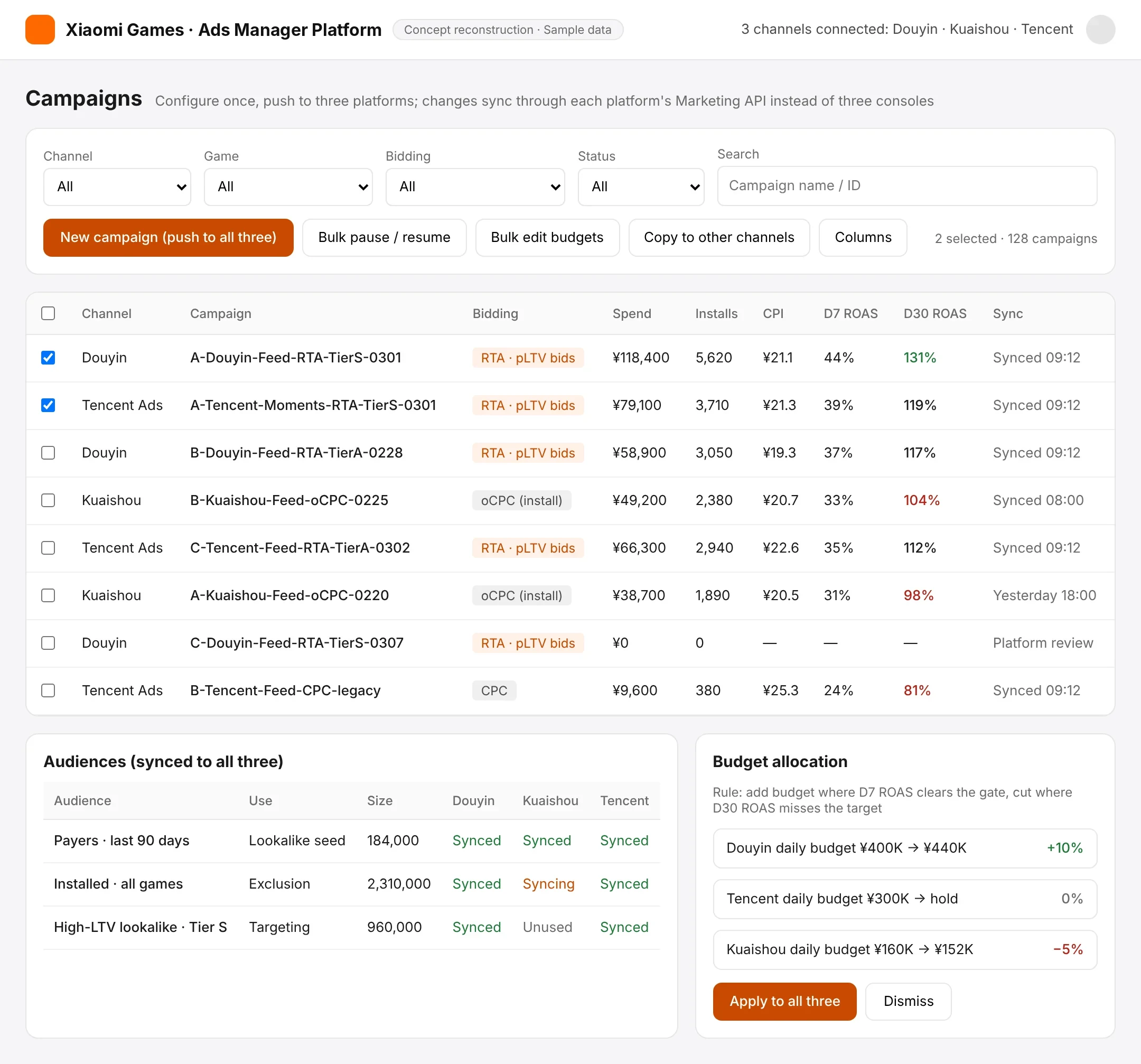
One console for ByteDance's Douyin, Kuaishou and Tencent. Set a campaign up once and push it to all three; pause, resume and re-budget in bulk; move budget between the platforms by ROAS, instead of logging into three back-ends.
一个后台管三家:抖音(字节)、快手、腾讯。一处配置、三家下发;批量起停、批量改预算;预算按 ROI 在三家间调,不用分别登录三个后台。
3.7× the daily spend~$30K → ~$110K a day as ROAS rose, all run from one console日投放 3.7 倍:随 ROI 上升,日均约 $30K → $110K,都在一个后台里跑
Concept reconstruction from memory; numbers are illustrative and consistent with the case study. No proprietary data or screenshots.Open the clickable mock-up ↗2RTA + bidding by user valueRTA + 价值出价
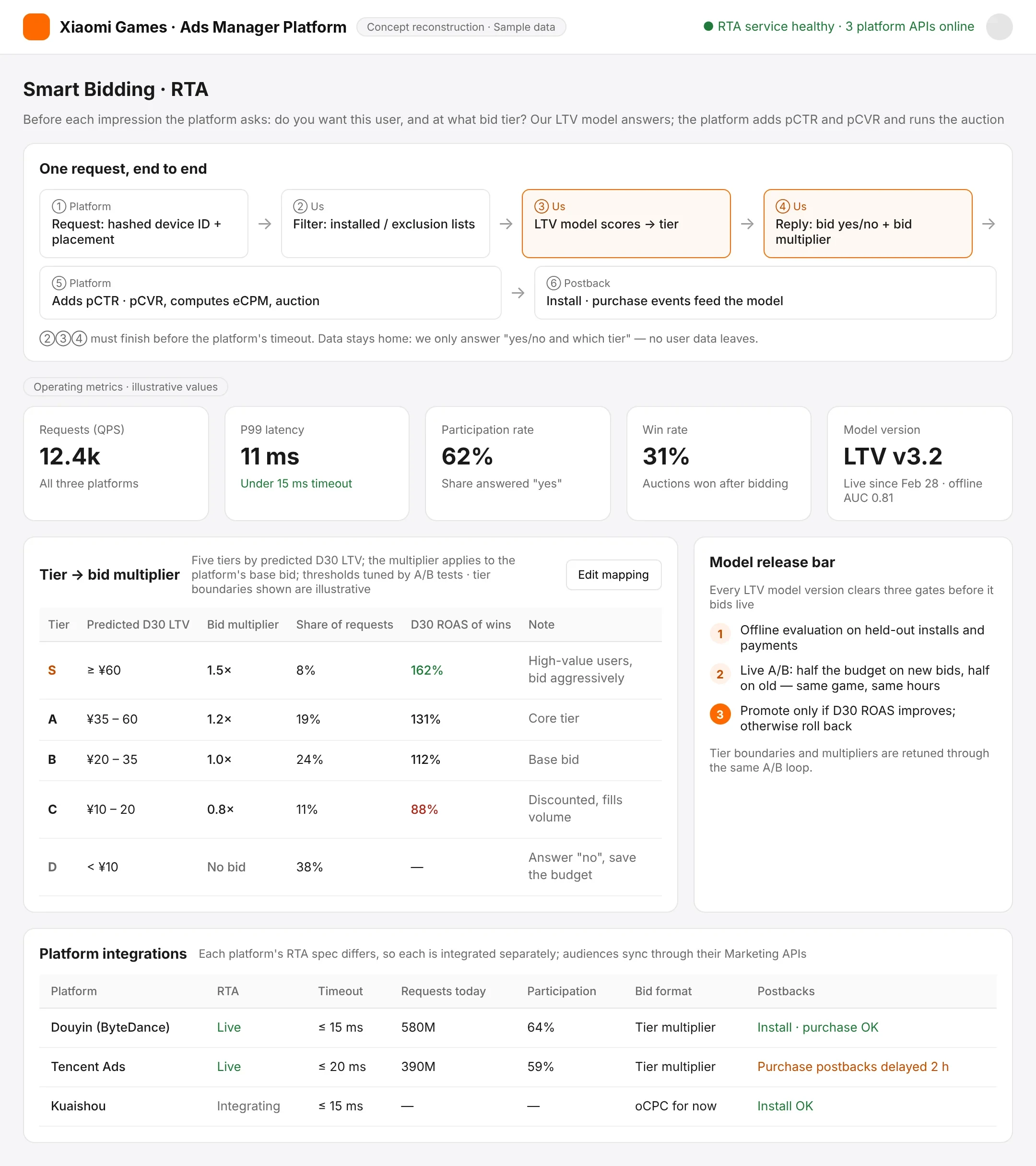
Bid by what a user is worth, not by what a click costs. Before each impression the platform asks, through RTA, whether we want this user and at which bid tier. Our model predicts what the user will spend in their first 30 days (the console calls it LTV, lifetime value); the platform adds its own click and conversion estimates; the two combine into one bid.
30-day ROAS 10% → 120%$0.10 → $1.20 back per $1 of ads30 日 ROI 从 10% 到 120%
Concept reconstruction from memory; numbers are illustrative and consistent with the case study. No proprietary data or screenshots.Open the clickable mock-up ↗3Ad creative at scale素材批量生产
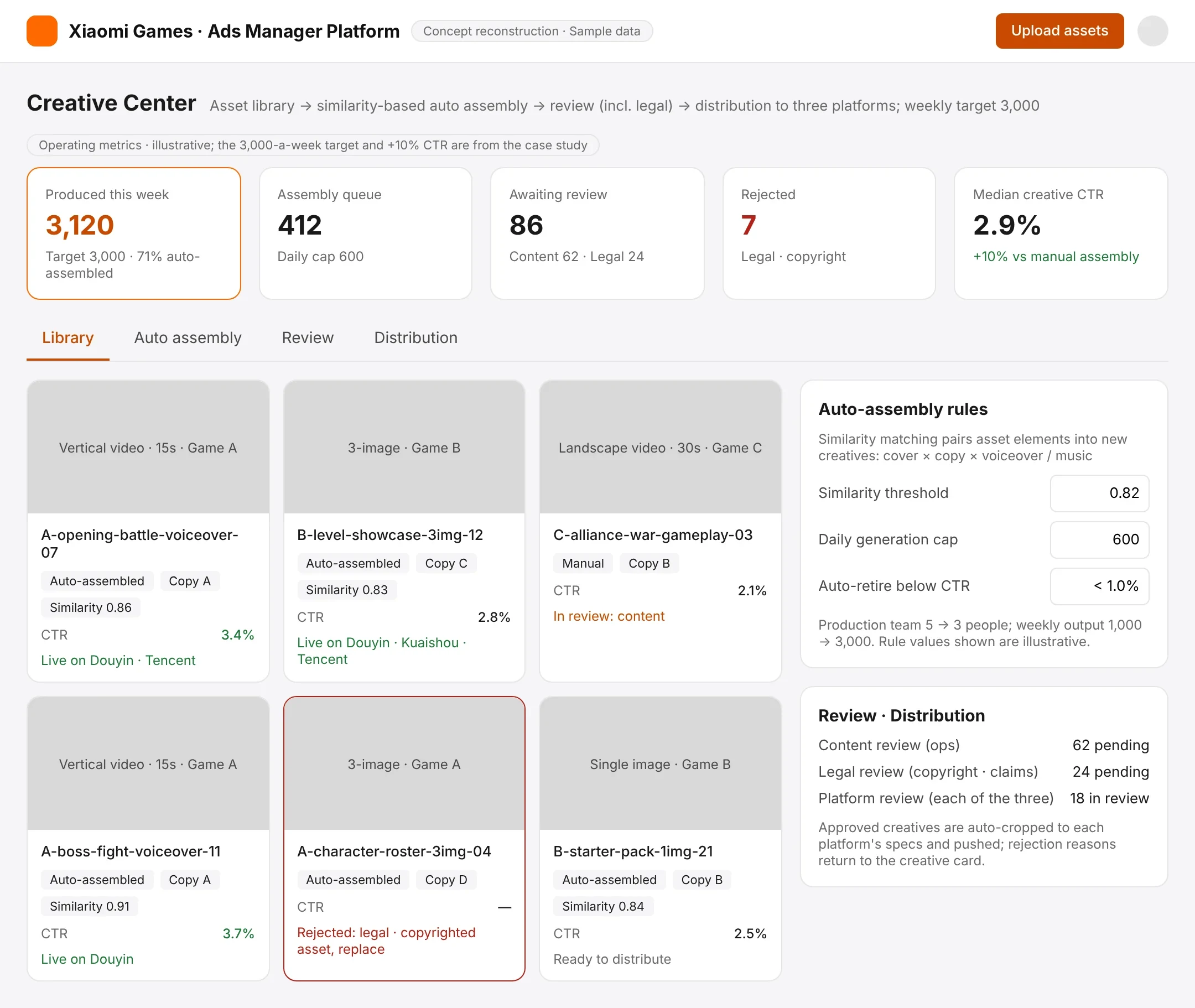
Ads assembled by similarity. The algorithm learned which image, headline and button combinations had performed, built new ads from pieces that resembled them, and a person reviewed every one before it went live.
1,000 → 3,000 ads a week5 → 3 people · CTR +10%周产量 1,000 → 3,000,团队 5 → 3 人,CTR +10%
Concept reconstruction from memory; numbers are illustrative and consistent with the case study. No proprietary data or screenshots.Open the clickable mock-up ↗
Result at the mature stage: 30-day ROAS 10% → 120%, and $45M+ a year spent in games by the users we acquired.
稳定阶段的结果:30 日 ROI 从 10% 到 120%,买来的用户每年在游戏里消费 $45M+。
11The result结果
12× the money back, and $45M+ a year.每块钱带回的钱翻 12 倍,一年 4,500 万美元以上。
User spending back on every $1 of ads, within 30 days每 1 美元广告费,30 天内带回的用户消费
Manual targeting人工定向$0.10
Machine-learning bids机器学习出价$1.20
12× more. In ROAS terms, 30-day ROAS rose from 10% to 120%. User spending is shared with game studios.提升 12 倍。按 ROI 口径,30 天 ROI 从 10% 到 120%。用户消费需要和游戏厂商分成。
$45M+
a year in user spending from the users we acquired (annualized)买来的用户一年在游戏里的消费(年化)
3.7×
daily ad spend once 30-day ROAS reached 120%: efficiency first, then scale30 日 ROI 到 120% 以后,日投放加到 3.7 倍:先效率,后规模
Also: ad creation, automated另外:广告素材生产自动化
Ads used to be put together by hand: 5 people made about 1,000 a week. I led the switch to an ML-based algorithm that learned which mixes of image, headline and button had worked before and assembled new ones, with people reviewing each. Working with marketing and ad operations, 3 people then made 3,000 ads a week, and the new ads had a 10% higher click rate.
3× the output with a 40% smaller team.产量 3 倍,团队人数少 40%。
Part 2第二部分
Ad Platform (selling ads), Xiaomi Browser广告平台(卖广告),小米浏览器
Tripled revenue from reading-app ads, and grew advertisers from 1 to 5阅读类广告收入翻 3 倍,客户从 1 家做到 5 家
I owned the ad recommendation strategy for Xiaomi Browser's news feed. I made reading-app ads more relevant to users, then used the results to win new advertisers.我负责小米浏览器信息流的广告推荐策略:让阅读类广告更贴合用户,再用这些成绩拉来新客户。
The business业务
Xiaomi Browser is the web browser built into Xiaomi phones, and it has a news feed. Free reading apps buy ads in that feed to win new users, and pay us for each click.
Strategy product manager for reading-app ads. I set the recommendation strategy and designed the A/B tests, and the machine-learning team built the models. I also created the case study, technical presentation and pilot packages, and signed new advertisers together with our sales team.
Traffic was never the problem. Matching was.流量从来不是问题,匹配才是。
Reading-app ads sat at the low end of industry norms. Few people clicked, fewer installed, and 9 in 10 new users were no longer reading a week later. Our one reading-app advertiser was losing money: each $1 of ads earned back about $0.70 within six months.阅读类广告的表现在行业常见水平的下沿:点的人少,装的人更少,一周后九成新用户已经不读了。唯一的阅读类客户在亏钱:每 1 美元广告费,半年内只赚回约 0.7 美元。
On cost-per-click inventory (ad slots the advertiser pays for only when someone clicks), revenue is impressions (how many times ads are shown) × click-through × price per click. The feed's impressions were fixed — I didn't own the traffic. So the only question worth asking was: how do we make each impression worth more?按点击计费的广告位,收入 = 曝光 × 点击率 × 单次点击价格。信息流的曝光是固定的——流量不归我管。所以唯一值得问的是:怎么让每一次曝光更值钱?
ImpressionsFixed. Not mine to grow.固定,不归我管
×
Click-throughBetter matching — see What I did匹配更准 — 见「我做了什么」
×
Price per clickAdvertisers bid up when their ads pay off — see Go-to-market广告回本了客户才会加价 — 见「客户拓展」
The advertiser's problem and mine were the same problem: a reading app that loses money on our traffic cuts its budget, and the feed earns less. So their 180-day payback became my guardrail.客户的问题和我的问题是同一个:阅读类 app 在我们这买量亏钱就会砍预算,信息流就赚得少。所以他们的 180 天回本成了我的护栏指标。
2Ad recommendation strategy广告推荐策略
Before the click, and after it.点击之前,和点击之后。
Before the click, make the match better. Pull candidate ads from several sources instead of one (multi-channel recall). Rank them by how likely this user is to click, weighed against what the advertiser bids, rather than by clicks alone (the ranking model). Start from users who already installed and find others like them (lookalike seeds). And never show the same ad a fifth time (a frequency cap).点击之前,让匹配更准。候选广告从多个来源捞,不只一路(多路召回)。排序看这个用户多大概率会点、再乘以客户的出价,而不是只看点击率(排序模型)。从已安装的用户出发找行为相似的用户(相似人群种子)。同一条广告不给同一个人看第五遍(频控)。
After the click: keep the story going.点击之后:让故事继续。
I found this half by breaking the funnel down step by step — click, install, open, first chapter — and looking for the worst drop. It wasn't the download. People installed, opened the app, and couldn't find the book the ad had promised.这一半是拆漏斗找出来的——点击、安装、打开、读到第一章,看哪一步掉得最狠。不是下载那一步。用户装了、打开了,却找不到广告里承诺的那本书。
Deep links (opening the exact page, not the app's front door), pre-loading, fewer steps to the first chapter, landing page matched to the ad. Deep links and pre-loading moved conversion (clicks that became installs); matching the landing page to the ad — opening on the book's best chapter — is what doubled retention (users still reading a week later). Toggle Before / After.直达下载、预加载、更少步骤读到第一章、落地页和广告一致。前两项提的是转化率;真正让留存翻倍的是落地页和广告一致——打开就是那本书最精彩的章节。切换优化前 / 后。
3Go-to-market客户拓展
Turning one advertiser's numbers into four more.把一家客户的数字,变成另外四家。
The first advertiser's payback was the only proof that travelled. Reading apps don't buy a promise; they buy someone else's numbers.第一家客户的回本数据是唯一传得出去的证据。阅读类 app 不会为一个承诺买单,他们买的是别人跑出来的数。
Who had to say yes.客户那边,谁要点头。
A reading app's budget took more than one yes, and each person had a different worry.
阅读 App 的预算不是一个人点头就够,每个人担心的事都不一样。
On the advertiser's side客户那边的人
Their worry他担心什么
What answered it靠什么解决
The ad optimizer, who runs campaigns day to day每天投放的优化师
Few users clicked, and fewer installed.点的人少,装的人更少。
Better matching doubled click-through and install conversion.推荐更准,点击率和安装转化率各翻倍。
The growth or product lead, who decides whether the channel gets budget增长或产品负责人:决定这个渠道给不给预算
9 in 10 new users stopped reading within a week; each $1 of ads earned back about $0.70 in six months.新用户一周走掉九成;每 1 美元广告费半年只回约 0.7 美元。
A technical presentation of the mechanics, plus one page of the first advertiser's numbers: 180-day ROAS 70% → 110%.讲清机制的技术演示,加一页第一家客户的数据:180 日 ROI 70% → 110%。
Whoever signs off the budget, the founder or finance批预算的人:老板或财务
A new channel is an expensive bet.新渠道试错成本高。
A low-barrier pilot, judged on their own numbers.低门槛试投,用他们自己的数据判断。
Our own sales team, helping persuade帮着说服的人:我们自己的销售
Needed something an advertiser could grasp in minutes.需要一份客户几分钟就能看懂的材料。
The one-page case study and the technical presentation, which I made.我做的一页案例和技术演示。
The advertiser's engineers, who could stall it可能卡住的人:客户的研发
Deep links and landing-page changes cost them time and people.接深链、改落地页要排期、占人手。
Targeting, creative templates, frequency caps and landing-page templates, packaged so an advertiser plugs in.定向、素材模板、频控、落地页模板都打包好,接上就能用。
PositionOne page of the first advertiser's numbers — cheaper installs, users who stay — and one sentence of value.定位:把第一家客户的数据做成一页案例——获客更便宜、用户留得住——价值说成一句话。
PackageTargeting, creative templates, frequency caps and landing-page templates, configured for reading apps, so a new advertiser plugs in instead of starting from scratch.打包:定向、素材模板、频控、落地页模板,按阅读类 app 配好,新客户接进来就能用,不必从零配。
PromoteTechnical presentations to the advertiser's own product and growth leads — the mechanics, not a sales deck — then a low-barrier pilot so they could read their own numbers before committing.推广:给客户的产品和投放负责人做技术型演示,讲机制不讲销售话术;再给低门槛试投,让他们看自己的真实数据再决定。
Outreach and contracts were commercial's; what to pitch and how to make it cheap to try were mine.触达和签约是商务的事;拿什么去谈、怎么让他们试得起,是我的事。
4The result结果
Four numbers doubled, and the feed tripled.四个指标翻倍,信息流收入翻了三倍。
Every change was A/B tested on randomly split users, so each number below is a measured difference, not a before-and-after of the whole business.每项改动都在随机分组的用户上做 A/B,所以下面每个数字都是测出来的差值,不是整条业务的前后对比。
Before之前After之后
Click-through rate1.5% → 3%点击率
1.5%
3%
2×
Click-to-install conversion5% → 10%安装转化率
5%
10%
2×
7-day retention10% → 20%7 日留存
10%
20%
2×
First advertiser's 180-day ROAS70% → 110%: from losing money to profitable首家客户 180 日 ROI:从亏到赚
70%
110%
Profitable
3×Ad revenue from reading-app advertisers, ~$50K → $150K a day阅读类客户广告收入,约每天 $50K → $150K
1 → 5Reading-app advertisers, won with a case-study-led go-to-market客户数,靠案例开路的 GTM
A/BEvery change tested on randomly split users每项改动都在随机分组用户上做 A/B
1What I bring我能带来什么
What this means for your team.这对你的团队意味着什么。
I can do the math for both sides.两边的账我都会算。
What an advertiser gets back for every dollar, and what a platform earns from its traffic.
广告主每花 1 美元能带回多少,平台的流量能变现多少。
I take products from 0 to 1.我能把产品从 0 做到 1。
With large cross-functional teams, from roadmap to launch.
带大型跨职能团队,从路线图一直到上线。
I know when machine learning is worth it.我知道什么时候值得上机器学习。
And what data it needs before it can help.
以及上之前要先准备好什么数据。
2Under the hood技术细节
For readers who want the details.给想看细节的读者。
How the bidding rule, the value model, the ad-creation algorithm and the feed recommender actually worked, plus a glossary of the terms used above.出价规则、价值模型、素材算法和信息流推荐具体怎么运作,外加上面用到的术语表。
How the bidding rule worked出价规则怎么运作
A model predicted each new user's spending over their first 30 days, a short-term version of lifetime value (LTV). Below a threshold, we didn't bid. Above it, the bid rose with the predicted value, capped so that bid ≤ predicted value ÷ target ROAS. In practice the platforms' RTA interfaces take a multiplier on the platform's own base bid rather than an absolute price, so the rule was applied as value tiers, each mapped to a multiplier — which is what the Smart Bidding screen above shows. Each model was checked offline first, then A/B tested live: half the budget on the new bids, half on the old.
Why 30-day ROAS was the north star为什么北极星指标是 30 天 ROI
Installs are easy to buy cheaply, and spend can always go up. 30-day ROAS (user spending within 30 days ÷ ad spend) captures both cost and value. It is also the earliest reading that tracks long-term value, since spending on a game plays out over 90 to 180 days.
We broke past ads into parts (image, headline, button), measured which combinations had drawn clicks and installs, and assembled new combinations from the strongest parts. People reviewed every ad, and the delivery system shifted budget toward the ones that performed.
How the news-feed recommendations worked信息流广告推荐怎么运作
Recall: gather candidate ads from several channels, such as a user's interests, similar users, trending titles and recently clicked categories. Ranking: score each candidate on how likely the user is to click and to install, using reading behavior and ad features such as cover style and copy. Frequency capping: limit how many times one user sees the same ad in a day.
Return on ad spend: revenue from the users an ad brought in ÷ what the ad cost, so 120% means $1.20 back per $1. China's ad industry calls this same ratio ROI.广告花费回报率:广告带来的用户产生的收入 ÷ 广告花费,120% 即每 1 美元回 1.2 美元。国内广告圈把这个比值叫 ROI。
RTA
Real-Time API. Lets an advertiser decide, ad slot by ad slot, whether to bid and how much.实时接口。让广告主逐个广告位决定要不要出价、出多少。
LTV
Lifetime value. How much a user is expected to spend over time.用户终身价值。预计一个用户长期会花多少钱。
Click-through rate
Clicks ÷ times an ad was shown.点击率:点击次数 ÷ 广告展示次数。
Conversion rate
Installs ÷ clicks.转化率:安装次数 ÷ 点击次数。
7-day retention
Share of new users still using the app a week after installing.7 天留存:装机后第 7 天还在用的新用户比例。
Lookalike targeting
Finding new people who behave like your best existing users.相似人群定向:找和已有优质用户行为相似的新用户。
A/B test
Randomly splitting users into two groups to compare a new version with the old one.A/B 测试:把用户随机分成两组,比较新旧方案。
Frequency cap
A limit on how often one person sees the same ad.频控:限制同一个人看到同一条广告的次数。